Underwrite a DealUpdated Sep 13, 2026Investors modeling a park value-add plan
Most park value-add plans come down to the same three moves: fill the empty pads, put homes on the ones that need them, and — if the land allows — build more. Mogul Deal Evaluator models all three in one place, the Leasing & infill plan, and keeps the money that pays for them in the sections that already own capital and expenses.
The four moves
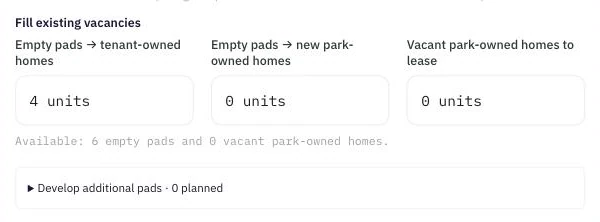
Open Edit leasing plan from the Park Income card. The first three fill inventory you already own:
Empty pads → tenant-owned homes — you lease a bare developed pad to a resident who brings their own home. New income is lot rent only.
Empty pads → new park-owned homes — you install a home on a bare pad and lease both. New income is the lot portion plus the home-only portion.
Vacant park-owned homes to lease — the home is already there and empty; leasing it earns the lot portion plus the home-only portion.
The fourth is expansion, kept collapsed under Develop additional pads because most deals don't use it: enter your Potential undeveloped pads, how many you will develop & lease, and how many of those will carry park-owned homes. The remainder are tenant-owned.
You cannot plan more than you have
Infill is planned against the inventory you actually have — the line under the fields names what is available.
The plan is checked against the inventory when you save, and the modal shows what is available beneath the fields. Each limit is separate:
Pads filled with tenant-owned homes cannot exceed your vacant pads.
Pads filled with tenant-owned homes plus pads filled with new park-owned homes cannot exceed your vacant pads either — the two draw on the same empty pads.
Park-owned homes you lease cannot exceed your vacant park-owned homes.
Pads you develop cannot exceed your potential undeveloped pads, and the park-owned share of them cannot exceed the number you are developing.
When a save is rejected, read the message against the specific limit it names, then decide which side is wrong:
Compare the planned count with the matching available count — the modal prints both, and the failing rule names the pair.
If the plan asks for more than the park has, reduce the plan. A park with six empty pads cannot fill eight, and the model is right to refuse. This is the usual cause.
Correct the inventory only when the recorded counts are actually wrong — a pad you forgot to enter, or vacancies that moved since you built the deal.
Never raise an inventory count to get a plan past validation. The inventory is also your pad count, your physical occupancy and your potential rent — inflating it to unlock a plan silently overstates the park you are buying, and every figure downstream inherits the error. A rejected plan that exceeds real inventory is the model telling you the business plan does not fit the park.
New-lease rents
Infill is priced with its own three rates — Tenant-owned lot, Park-owned lot, and Home-only portion — separate from the in-place rents in Edit inventory & rents. They apply to exactly the leases this plan creates: the vacant pads and homes you fill, and the pads you develop. Everything already occupied keeps earning its current rate, which is what the editor means by "model new leases without repricing occupied residents."
What this is not: a turnover schedule. The model has no concept of an occupied resident moving out and a replacement signing at the new rate — there is no move-out, renewal or re-lease input anywhere in the park model. New-lease rates reach vacant and newly built inventory only. If your business plan depends on repricing occupied pads as leases roll, that is an assumption you carry outside this model; note it under Sources & rent evidence rather than expecting the leasing plan to produce it.
A rate you never set inherits the matching current rate, so a plan with no rent strategy still models honestly. The New-lease rent basis chooser gives you a starting point — Use current rents or Use market evidence when park comps are loaded — and every field stays editable afterwards. One caveat the panel states directly: the market figure offered for the park-owned lot is the same lot-rent benchmark used as a proxy; it does not include a home-only portion.
Delivery timing, and partial-period income
The Delivery schedule is two fields: the First month and the Last month of your leasing period. Everything you planned is delivered evenly across that window, and each new lease earns a full month of rent in the month it lands.
This is why a lease-up year shows far less than a full year of new income — and the gap is bigger than the lease count suggests. Take a plan running months 4–15: by the end of Year 1 three-quarters of its leases have been signed, but because each one only earns from the month it lands, Year 1 collects about 31% of the income the finished plan will produce. Year 2 carries about 98%, and Year 3 is the first fully loaded year. Deliveries scheduled past your hold period never inflate hold-period income. It is an aggregate planning model, not a tenant-by-tenant lease schedule.
One more effect worth expecting: when you fill a pad, the model stops charging its old potential rate and starts charging the new-lease rate — so potential rent moves with the plan as well as collected rent.
The running costs infill adds
More occupied pads cost more to operate. Enter that as a single annual run rate in Park Operating Expenses → Infill operating costs → Added operating costs / year: the annual cost at completed infill. It ramps in with your deliveries rather than landing all at once, and afterwards it grows with your expense-inflation assumption.
Keep these costs out of your ordinary expense rows. The expense rows describe the park as it operates today; this field describes what infill adds on top. Entering the same dollars in both places double-counts them and quietly understates NOI in every projection year.
Where park capital belongs
Capital lives in Infrastructure & Capital Projects. You have two ways to record it, and the difference matters:
Park capital budgets — two summary figures, Infill & home make-ready and Infrastructure improvements. Both are treated as additional equity funded at closing: they are counted once in total capital and in non-financed capital.
Itemized capital rows — the ordinary capital table, for work you want listed separately or financed. Park deals get purpose-built suggestions here: road and drainage improvements, water and sewer systems, electrical distribution, pad development, and park-owned-home make-ready.
Use one or the other for a given dollar — never both. If you itemize your road project as a capital row, leave it out of the Infrastructure improvements budget (a zero budget is fine). The modal states the rule where you enter the number: exclude amounts already entered in the CapEx rows. Replacement reserves remain separate from both.
Utilities, approvals and the assumptions behind the plan
An infill plan is only as good as the permission and capacity behind it. Deal Setup → Review park facts is where those live, one topic per section:
Water — supply, ownership, meters and permits.
Sewer / septic — capacity, ownership and inspections. Capacity is the constraint that most often kills an expansion plan.
Electric / gas — distribution and who is responsible for it.
Roads & drainage — condition, fire access and deferred maintenance.
Approvals, leases & risks — licensed pads, zoning, infill approvals, home titles, rent rules, environmental and flood exposure.
Sources & rent evidence — where your numbers came from, their dates, and what is still unresolved.
These notes are yours; Mogul Deal Evaluator stores and reports them, and does not verify them. Where a supported public registry has a record for the park, Market Insights can offer its water, sewer and age-restriction facts as text you may add — labeled with the source and its date. Everything else is your diligence.
Common mistakes to avoid
Planning infill you have no approval for. Model the plan, then record the approval status next to it.
Repricing the whole park to model a rent strategy. Raising the in-place rate raises rent on every occupied pad in that group, immediately and in Year 0. New-lease rates are the right place for the rents you expect on the leases this plan creates — but they reach only that new inventory, so neither field models occupied pads repricing over time.
Forgetting the operating cost of a full park. A plan that adds income and no expense flatters NOI.
Funding the plan twice — a budget figure and an itemized row for the same work.
mobile home parkMHPinfillleasing planinfrastructurepark capitalpad developmentdelivery