Wholesale underwrites an assignment: you put a house under contract and sell that contract to an end buyer for a fee. Two parties, two sets of economics — and Mogul Deal Evaluator deliberately shows both, because your fee only gets paid if the deal still works for the buyer who closes on it.
Your inputs are the contract price you're negotiating with the seller and your assignment fee. Your profit is the assignment fee — counted once, paid when the end buyer closes. Simple on purpose: the hard part of wholesale isn't your math, it's whether the buyer's math survives your fee.
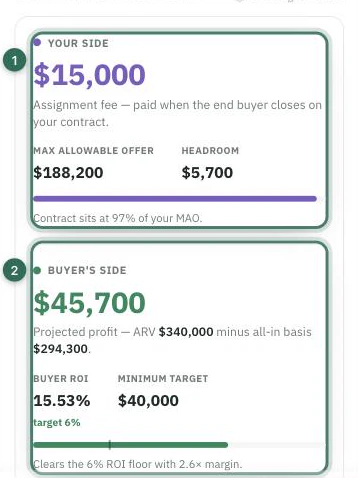
The rest of the inputs describe the deal the end buyer is stepping into — their repair estimate, holding and selling costs, closing costs, the after-repair value, and their minimum profit target. From those, Mogul Deal Evaluator computes the buyer's projected profit and ROI on their all-in basis (contract price + your fee + all their costs).
These are modeled figures for a typical investor-buyer, not a promise about how any particular buyer will underwrite — but if the modeled buyer loses money, real buyers will notice too. A wholesale deal with no buyer profit is a contract you'll struggle to assign.
The max allowable offer (MAO) is the most you can put the house under contract for while the deal still leaves room for everyone. It's built by subtraction, and the "How the ARV splits" view shows every step: start from the ARV, take out the buyer's project costs, take out their minimum profit target, take out your assignment fee — what remains is the ceiling on your contract price.
No 70% rule or any other rule of thumb is hardcoded — the MAO comes entirely from the numbers you enter. The workspace compares your contract price to it live and shows your headroom: contract below MAO means room to breathe; above it means someone's slice has to shrink, and it's usually yours.
The whole strategy is a negotiation between four numbers, so test them: ARV at your comp-supported value vs the seller's story; repairs at your walk-through estimate vs a contractor's; your fee at the number you want vs the number that keeps the buyer whole. Comparing scenarios shows exactly where the deal stops working for the person who has to close it.