Underwrite a DealUpdated Sep 3, 2026Investors stress-testing an underwrite
Sensitivity Analysis answers the question every serious underwrite eventually faces: "how much does my result move if this assumption is wrong?" It re-runs your analysis across ranges of the assumptions that matter most, so you can see which numbers your returns actually hinge on — before the market shows you.
What's in the section
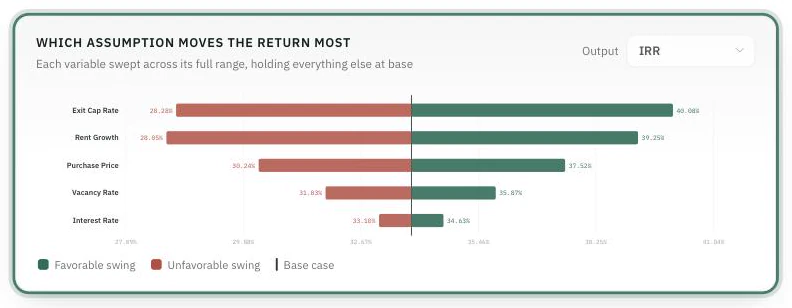
Longest bar at the top: the assumption your return is most exposed to.
The tornado — "which assumption moves the return most": each tested variable as a bar, ranked by impact. Ten seconds here tells you where your diligence time belongs.
One-way ladders — sweep one assumption while everything else holds: Exit Cap Rate, Rent Growth, Vacancy Rate, and Interest Rate (when the deal carries debt), plus the Purchase Price ladder (its own guide: Purchase Price Sensitivity). Outputs per case: IRR, equity multiple, and value at exit.
The heat map — two variables at once: exit cap rate against income growth, with IRR in each cell. This is the honest picture of the classic downside pair — softer exits and weaker growth usually arrive together.
On a mobile home park, read the vacancy ladder carefully: it sweeps the projection collection-loss rate, because a park's physical vacancy is already modeled by its pad inventory and leasing schedule. To stress physical vacancy on a park, change the inventory or the infill plan — not this rate.
Everything here is display-only exploration: nothing rewrites your saved scenario.
How to actually use it
Open the tornado. Note the top one or two bars — that's what your deal really depends on.
Sweep those variables' ladders and find where the deal stops clearing your Buying Targets. The distance between your assumption and that break point is your margin of safety.
Check the heat map's downside corner — the "cap rate drifts out while growth disappoints" cell. If that cell is unlivable, you've learned the deal's true risk shape.
For a coherent full downside world (several assumptions moved together), build a scenario instead — sensitivity is for one-variable questions; scenarios are for alternative realities.
Not a prediction
Sensitivity doesn't say which case will happen — it says what each case would do. A deal that only works in the friendliest column of every ladder isn't a bad deal by decree; it's a deal whose risk you now see plainly. What to do with that is your call.
Availability
Sensitivity lives in the Advanced Analysis band of the detailed workspace and requires the advanced-underwriting capability on the deal owner's plan — without it the section shows exactly what upgrading unlocks.
Common questions
"No interest-rate ladder?" — It appears when the deal carries debt; an all-cash analysis has no rate to sweep.
"The ladders cleared." — Sensitivity output is ephemeral by design; recalculate after assumption changes so you're never reading a stale sweep.